Graduate Research
I am mainly interested in technology development for single-cell omics with applications in immunology. I am also completing a concentration in Computer Science and enjoy working on computational methods to apply to high-throughput genomic data.
I have completed rotations at the Broad Institute with Paul Blainey and Nir Hacohen.
Undergraduate Research
The Role of Tim-1 in Regulatory B Cells
Dr. Vijay Kuchroo’s Group, Harvard Medical School
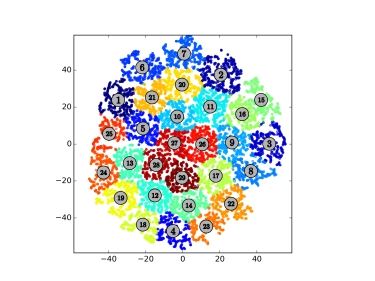
- Populations of CD3+ cells clustered through tSNE based on cytokine expression
I helped investigate effects of anti-inflammatory regulatory B cells (Bregs) on T cell proliferation. I clustered cytokine expression data using Barnes-Hut SNE and hierarchical clustering in R to elucidate differences between WT mice and mice with Tim-1 conditionally knocked out on B cells. I also optimized a dye-based assay to assess T cell proliferation.
IRAK1 Clusters under Dual TLR Ligand Stimulation
Dr. Iain Fraser’s Lab, NIH Summer 2015
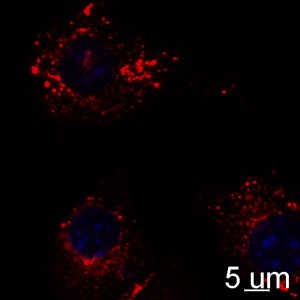
- IRAK1 (in red) clusters under dual ligand stimulation
In the Fraser lab, one of my projects involved studying IRAK1, a key protein in the TLR signaling cascade, which clusters upon dual TLR ligand stimulation. In addition to wet lab experiments, I also realized that better data analysis and visualization tools could greatly enhance my work on quantifying IRAK1 protein clusters in high-content imaging data. I taught myself how to program in R and developed scripts for data dimensionality reduction, heatmaps, and viewing correlations between many output variables.
Recombinant BDNF Protein Production
Dr. S. Patrick Walton’s Group, Michigan State University, 2015-2016
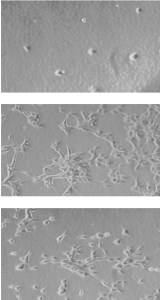
Recombinant BDNF induces cell proliferation (top: – ctrl, middle: + ctrl, bottom: purified recombinant BDNF)
I helped optimize a protocol for expression and purification of brain-derived neurotrophic factor (BDNF) in B. choshinensis. BDNF has therapeutic applications in a variety of neurological disorders; however, it is difficult to produce recombinantly, making its use prohibitively expensive. The procedure that I helped design and optimize yields high quantities of bioactive BDNF at a much lower cost than other procedures. In particular, I optimized bioactivity measurement of the protein via an Alamar Blue proliferation assay in 3T3 cells expressing a BDNF receptor (TrkB). I took images of proliferating cells and developed an analysis pipeline using ImageJ to align images taken over the course of five days. You can read more about this work in our paper.
siRNA Functional Asymmetry
Dr. S. Patrick Walton’s Group, Michigan State University, 2013-2015
I helped investigate siRNAs, double-stranded RNAs able to silence a complementary mRNA. Since unwanted off-target effects may result if the undesired siRNA strand is selected, we aimed to elucidate the role of two key sequence-specific parameters on siRNA strand selection and, ultimately, on mRNA knockdown efficiency. I helped develop assays to examine siRNA strand loading in RISC, the silencing complex that mediates mRNA degradation. In addition, I independently optimized a chemiluminescence assay to measure knockdown efficiency of each siRNA strand. These two key pieces of data allowed us to validate the overall predictive value of the two parameters the lab had previously identified and, interestingly, demonstrated that strand loading into RISC is not always correlated with knockdown efficiency. You can read more about this work in our paper.
 Rebecca J. Carlson